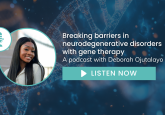
Breaking barriers in neurodegenerative disorders with gene therapy: a podcast with Deborah Ojutalayo
 We’re joined by Deborah Ojutalayo (right), a senior research associate at AviadoBio (London, UK), to discuss gene therapies for neurodegenerative disorders, with a particular focus on targeted gene therapies for frontotemporal dementia caused by mutations in the GRN gene.
In this episode, Deborah delves into how gene therapies are enabling researchers to address the root causes of conditions rather than just managing their biological symptoms. She discusses how AviadoBio is pioneering targeted gene therapies for neurodegenerative disorders, and provides insights into her day-to-day activities as a senior research associate working on progression of AAV-based gene therapies for a large scope of neurodegenerative diseases.
In this conversation, Deborah also shares her journey into the field, offering valuable advice for those looking to break into the biotech industry, and touches on how she is creating a space through social media for aspiring professionals to learn and grow.
Disclaimer: The opinions expressed in this interview are those of the author and do not necessarily reflect the views of RegMedNet or Taylor & Francis Group.
Podcast transcript
[00:07] Kadeja Johnson: Hi, I’m Kadeja, a digital editor of RegMedNet. On this podcast episode, we’re joined by Deborah Ojutalayo, who is a research associate at AviadoBio, to talk about gene therapies for neurodegenerative diseases, like frontotemporal dementia. Thank you for joining us today, Deborah. Before we start, please would you mind introducing yourself and tell us a little bit about your role.
[00:33] Deborah Ojutalayo: Yes, of course. So my name is Deborah. Most people just call me Debs. I’m currently a senior research associate at AviadoBio and we are a biotech gene therapy company and its headquarters is in London. So I’ve been working at AviadoBio for coming up to five years now. So it’s been a good journey so far.
But in terms of my background, I studied biomedical science and then I went on to complete a master’s in immunology, which was influenced by COVID. I will say that COVID definitely made me take a large interest in the general scope of infection and immunity.
But in terms of my day-to-day role, so I work within the discovery department at AviadoBio, mainly working on the progression of AAV-based gene therapies for sort of a large scope of neurodegenerative diseases. So day-to-day, that involves a lot of hands-on laboratory work, particularly cell culture, cell-based assays, and just sort of evaluating our therapeutic candidates. So it’s a lot of close collaboration with different colleagues and different project teams.
[01:52] Kadeja Johnson: Thank you so much for providing that introduction to yourself and for telling us a little bit about your entry into this field and also what you do on a day-to-day basis. Can you tell us a little bit more about AviadoBio and how the company is developing targeted gene therapies?
[01:58] Deborah Ojutalayo: Yeah, so like I said, so we’re based in London. So the company actually started back in 2019. So they built upon research from King’s College London (UK) and the UK Dementia Research Institute (London, UK), and it’s since grown to where it is now. So I joined quite early on. I always like to say I was employee number eight, so I’ve really been here pretty much from the beginning. But essentially our mission is to develop highly targeted and potentially life-changing gene therapies for patients, particularly with frontotemporal dementia and other sort of tauopathies. So mainly we are looking at FTD-GRN, which is FTD caused by mutations in the GRN gene. So that’s our main aim, to help patients with those conditions.
[02:48] Kadeja Johnson: Amazing. Thank you so much for providing that overview. You’ve given me a few insights into what you do. Can you tell us about AVB-101, which is, as you mentioned, for frontotemporal dementia caused by the mutation in the GRN gene?
[03:03] Deborah Ojutalayo: Yes. So AVB-101 is our lead investigational program. It’s designed to essentially treat FTD caused by mutations in the GRN gene. And just, I guess, for a little bit of background, FTD is an early onset form of dementia and at present there’s no approved therapies for FTD-GRN. When individuals have a mutation in their GRN gene, there’s a deficiency in the protein called progranulin. And that protein is super important for neuronal health, regulating inflammation and just supporting normal lysosomal function of the brain. So when progranulin levels are too low, this is what causes the neurodegeneration and disease progression. So we want to supplement this back into the patient. And that’s where AVB-101 can potentially come in. So it’s an AAV-based progranulin gene supplementation therapy designed to restore this progranulin level in the brain. So we want to deliver this directly into the thalamus. And we’re hoping that by doing this, we can just bypass the blood-brain barrier to achieve maximum distribution as much as possible. So that’s our lead program at the moment.
[04:21] Kadeja Johnson: Amazing. Thank you so much for explaining that and for going into so much detail. I feel like I understand a lot more about how this therapy works and how AviadoBio is trying to achieve that. So we’ve obviously seen a rise in gene therapy for neurological conditions. How have advancements in gene therapy changed the way we approach complex and often unpredictable diseases like FTD?
[04:44] Deborah Ojutalayo: Yeah, so gene therapy has really changed how we approach neurological diseases. I think in the past, we viewed it as too complex or very unpredictable to treat. And when we look at how things were treated historically, a large part of that is simply managing symptoms versus tackling the actual underlying biology. Also, the brain is not that easy to access. And so that was probably a barrier before. But now, the amazing thing about gene therapy is that we can directly target well-defined genetic drivers of a disease in conditions like FTD-GRN, for example, where we are able to correct a biological deficit.
We also have improvements in AAV design and delivery strategies as well that will allow for more precise targeting. As I mentioned before, methods that allow us to bypass the blood—brain barrier opens up new therapeutic possibilities. So it’s providing new hope for patients and their families facing conditions that were previously considered untreatable.
[05:52] Kadeja Johnson: That’s fantastic. Thank you. Yeah, I think gene therapy is allowing us to access those areas that we once saw as inaccessible. And as you mentioned, rather than just managing symptoms, actually trying to address the root cause or the biological difficulties there. Thank you so much for answering.
And finally, you are an active creative and use your platform to inspire others. Reflecting on your career journey so far, what’s one thing you wish you had known while conducting your research and entering this exciting field?
[06:24] Deborah Ojutalayo: Do you know what? I always tell people, for me, this field of biotech and research and what I do now, it was really untouched territory. I didn’t really have role models or people who looked like me or people that I could easily relate to when navigating my career in science. I would say I didn’t fully understand what the field involved. And that’s why I started documenting and sharing videos on my TikTok and Instagram and showing people that this is what research looks like and hopefully making other people feel that they can access this too, right? Just making it more accessible for others. But I think for me, what I realized within the field and just research in general is that you will never reach your eureka moment.
I think growing up, as my love for science grew, I kind of thought to myself, OK, well, if there’s a problem, then fix it. You know, if you’ve got this, that and the other, get a bit of tape out, you know, glue it together. But obviously, research and science isn’t that straightforward. It’s a lot more complex than that. And I think that’s what makes it interesting. It’s like once you’ve answered one question, you’ve uncovered, I don’t know, three more, right? So it’s this continuous like thing. And I’ve just kind of learned that I will never probably have all the answers to everything, but that’s OK. And as I continue to ask more questions, I think that’s what will continue to make me a good scientist. So, yeah, just having that curiosity and that desire to dig more and ask more questions and stay engaged as well. And that’s it.
[08:10] Kadeja Johnson: Thank you for opening up and for telling us about what, you know, influenced your career and how you navigate and how you are navigating moving forward. As you said, it’s like a can of worms once you answer one question and another question pops up. And I think that makes you a great scientist by remaining curious, as you mentioned. Thank you so much for joining us today and for taking part in this podcast series with us. I hope to speak to you soon.
[08:17] Deborah Ojutalayo: Thank you very much for having me.