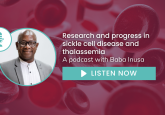
Research and progress in sickle cell disease and thalassemia: a podcast with Baba Inusa
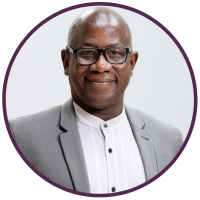 We’re joined by Baba Inusa (right), a pediatric hematologist and Professor at King’s College London (UK), to discuss research, progress, and the regenerative aspects of sickle cell disease and thalassemia.
In this podcast, Baba delves into his expertise in hematology, sharing what inspired his journey into this field of research. He also discusses the Academy for Sickle Cell and Thalassaemia (ASCAT) Conference, which he founded to unite experts and professionals working to tackle hematological disorders like sickle cell disease and thalassemia.
The conversation emphasizes the importance of early screening for individuals with these disorders – not only to advance research but also to empower patients and caregivers with a deeper understanding of how to manage these conditions. Baba also explores the emerging regenerative prospects in the field, which are paving the way for transformative change. These advancements offer hope beyond symptom management, aiming to address the root causes of these disorders.
Disclaimer: The opinions expressed in this interview are those of the author and do not necessarily reflect the views of RegMedNet or Taylor & Francis Group.
Podcast transcript
00:04 Kadeja Johnson: Hello everyone and welcome to this podcast episode on RegRedNet. I’m Kadeja, a digital editor and today I’m joined by Baba Inusa who will be talking to us about sickle cell disease and thalassemia and what the research, progress and regenerative aspects look like in this field. Thank you so much for joining us. If you don’t mind, please could you introduce yourself and tell us a little bit about your specialty.
00:28 Baba Inusa: I’m Baba Inusa and I’m a pediatric hematologist, but my main interest, particularly in terms of research and work, is sickle cell, thalassemia and rare anemia disorders. And I am a professor at King’s College London (UK), where my academic background is based, but I also used to work for Guy’s and St Thomas’ Hospital (London, UK), which is the NHS trust, and have left Guy’s and St Thomas’ Hospital about a year, two years ago to join a company which is a pharmaceutical company until now.
01:12 Kadeja Johnson: Thank you for giving that introduction of yourself, Baba. Can I ask, what inspired you to focus your research on sickle cell disease and global hematology? Are there any moments or experiences that have shaped your interest in this field?
01:28 Baba Inusa: Yes, so most of my interest in hematology stemmed from my medical school while I was in Nigeria and one of my mentors was a pediatric hematologist and her work was on sickle cell disease. And I think her interaction with patients and the impact she had on people’s lives was actually a major motivation for me. And also where I was practicing and actually possibly training the majority of significant long-term illnesses with sickle cell disease and some other hematological disorders. That’s how I got my interest. So it’s based on my academic experience and also observing somebody, how do I work in interacting with patients and making an impact in their lives.
02:21 Kadeja Johnson: Thank you for sharing that. And how has the awareness and treatment options of sickle cell disease and thalassemia changed throughout your experience researching this disorder?
02:32 Baba Inusa: Well, a lot has changed over the last 30 to 40 years. We’ve understood the basis of sickle cell disease actually over maybe 80 years ago, but the reality in terms of the impact on treatment and the impact on life has really dramatically changed. Whereas in the past, the majority of patients with sickle cell disease would die were very young. Now people live into old age and actually we have colleagues who are professionals do who have lived with sickle cell disease. So the management has transformed from basically supportive care, such as using folic acid or penicillin to prevent infections to the extent that there is care through bone marrow transplantation and also care through gene therapy. So there is a lot of progress being made, but currently we feel that the progress is slow and that is truly a need to really kind of invest more in terms of research to understand how the life of people living with sickle cell disease can be improved. So it’s not only about care, but also in terms of really providing therapies that actually can impact lives or changing lives.
And early diagnosis matters a lot because it helps the individual but also helps parents to be able to provide simple preventive care, such as making patients having the appropriate type of clothing or proper type of nutrition and also things that actually can prevent life. So the impact of early diagnosis cannot be overemphasized.
02:48 Kadeja Johnson: You’ve explained that very well. Thank you. Could you tell us a little bit about the Academy for Sickle Cell and Thalassemia, an initiative you founded?
04:36 Baba Inusa: Thank you. So the Academy started far back as 20 years ago, 2006. And we founded this to support training of frontline staff, particularly nurses and doctors. And this was mainly intended as a course in the first few years to provide introduction, introduce new staff to current management of sickle cell disease from diagnosis to treatment, and to making sure that they actually provide the appropriate care in hospitals and the community. To now a full-fledged scientific annual meeting that is not only limited to Europe, but actually involves the global participation from the US, Africa, Middle East. So it’s now has become a forum to really allow young people to showcase their work and also to meet some of their mentors, people they read about.
So it’s now a forum for academic exchange, interaction with patients, interaction with a lot of companies that actually would come to showcase their work in sickle cell disease. So the Academy has been really a grand platform to demonstrate what is best in the management of sickle cell disease as well as thalassemia as well. That’s why it has the two names.
06:12 Kadeja Johnson: Thank you for that detailed dive and for sharing so much about this foundation that you have founded. It’s great to create spaces like this that people can come together and share their research and share awareness and be in a space that gets the conversation going. Last year’s theme of the conference was “Haemoglobinopathies in focus, global advances, local disparities”. What were some of the highlights of the event?
06:46 Baba Inusa: So we had a record number of scientific abstracts that were presented at the meeting. Again, this was actually on a global platform where we had a lot of oral presentations, poster presentations that really enables academicians, industry, and also patients to actually see what is happening across the world and to also recognize some of the challenges that people are experiencing in terms of access to treatment. So you may have a treatment that is available, but accessing that treatment is important and that it’s quite variable according to economies and also according to where people actually live.
So we also had an opportunity to celebrate some of the people who are founding fathers in terms of what contribution they’ve made in terms of the management of sickle cell disease and understanding that. We also had a presentation by policymakers and particularly we had a member of parliament in Nigeria who is trying to work on a deal to establish treatment centers across Nigeria to tackle some of the issues to do with access, but also to provide better equity in terms of provision of care. We have similar emphasis looking at different aspects of really increasing access, improving the lives of people living with sickle cell disease, people living with thalassemia, and I think that was really kind of very important.
We also took note of the fact that quite some progress has been made in terms of early new therapies. We had a disappointment whereby two of the major therapies have been withdrawn. So again, that was really in focus on really just okay, how can we get a treatment that actually will really stand the test of time. Like hydroxyurea, which has been something that has remained a major focus of treatment.
08:58 Kadeja Johnson: Wonderful. Thank you for sharing. It seems that there’s a lot going on in this and it’s a growing initiative that I think needs more awareness on. That also leads me to ask, regenerative medicine has been a game changer in many areas of healthcare. How have advancements like gene therapy or stem cell research changed the trajectory of treatment for blood disorders like sickle cell disease?
09:26 Baba Inusa: So the research and advancement in terms of gene therapy and also some curative therapy, it is really kind of something that needs to go side by side as some of the standard management. And because this involves research with patients, it also helps in improving care because they will begin to understand what are some of the things that you need to do to make sure that this treatment is successful and that the treatment is also sustainable. And really knowing that sickle cell disease, the cause of sickle cell disease is a gene problem, which was actually the first disorder in human that actually was recognized to be a genetic disorder. And really for sickle cell disease, the benefit from gene therapy has shown that really we make quite some progress.
We also know that the current gene therapy that is available is actually not for all ages, but we are kind of expecting that more research will help us to understand how this actually can be provided from early on. Because gene therapy, quite similar to bone marrow transplantation, which is also a kill. Bone marrow transplantation is actually more successful in young children, whereas gene therapy would need to actually make sure that also young children can benefit from that.
But some of the challenges, however, is how do we select who goes and receive this expensive therapies? Who would actually best benefit? And so it’s not every patient that actually would have access to it, not only in terms of cost limitation, but also in terms of appropriate care and also the indication, because there are certain outcomes that actually we need to work on as well. So gene therapy, regenerative therapy, I mean, is actually very important in sickle cell disease progress.
11:27 Kadeja Johnson: Amazing. Thank you. And looking ahead, are there any emerging regenerative technologies or breakthroughs that you believe could revolutionize the way we treat hematological conditions, particularly for disorders like sickle cell disease and thalassemia?
11:47 Baba Inusa: Yeah, so there are so many new therapies, including treatment that actually are used for cancer. Also very, very important that actually it’s important to see how this actually can extend beyond cancer treatment, but also can benefit disorders like sickle cell disease, like thalassemia.
And so we can think about hematological conditions as malignant or non-malignant. And the malignant, which have to do with rapid proliferation like cancers therapies, there’s much more advancement in those particular arena of treatment. But a non-malignant or which are predominantly the inherited conditions like sickle cell, thalassemia, the treatment actually probably is slightly far behind. But again, most of them can actually benefit from each other. It’s just that there are issues in terms of how much investment is given in this area to make it progress. But definitely a lot of some of the treatment has transformed cancer care.
We need to make sure that similar treatment actually available for sickle cell disease and for thalassemia to really kind of benefit from them. That is a lot of room to, because even gene therapy is very different. Some of them is to edit, basically to say, okay, you cut and replace by cutting away some abnormal positions, you can allow the others to work. But also some of them is to say, okay, you can insert something into the gene that actually can work and make sure that that condition is almost functionally cured. And also, is there anything that we can do that can increase the production of some aspect of the blood that makes sickle cells much better? For example, fetal hemoglobin, which is a part of the blood that improves the oxygen delivery and the function of the red blood cell. That is the basis of one of the most recent approved gene therapy, produces, increases the production of the fetal hemoglobin.
And also, but another part of the gene that was approved was to produce a hemoglobin that is similar to the normal hemoglobin and increase that amount of volume in the blood. So there are various modalities. We are absolutely at the beginning.
So I would say we, I mean, almost not necessarily a proof of concept, but the fact that these are early phases and we’re hoping that more actually can be built on this. But also sometimes the hope is that rather than producing this gene therapy outside of the cell, if they can produce something that can easily be injected into the blood, that actually make a transformation is the next phase. And we’re hoping that a more program made in that.
A number of companies have tried and stopped, but we’re hoping that having more emphasis on that. And I know that a number of the big, some of the organizations like the Bill Gates foundation and some foundation have been working on what they call in vivo gene therapy, whereby you just inject it rather than working outside the rest and then put it back. So there’s a lot of room for progress.
And also there are a number of efforts to also produce, apart from cure to proceed therapies that transforms people’s lives. So there are some tremendous actually looking at how to, to, to increase the energy level of the red blood cell. Yeah.
So these were actually presented at ASCAT meeting to see how that can be improved, improve and reduce the breaking of the blood cells. Cause if the blood cell breaks, it leads to certain products that actually can be toxic to the system. So to reduce that and also reduces the, the kind of the tendency for the blood cell to sickle or basically twisting to the sickle type and leading to more breakage of the blood cell.
So a lot of work needs to be done and there’s a lot of room to make an impact in people’s lives. The ASCAT, for example, was kind of, ASCAT or the Academy of Sickle Cell and Thalassemia is based in the United Kingdom. We also have another foundation in Nigeria, which is called SCORE or Sickle Cell Cohort Research Foundation.
I can show you the website, but we, we established that and it was registered in 2013, but actually the work started in 2009, whereby we’re working to try to establish newborn screening for sickle cell disease because early diagnosis matters a lot. And by starting that, we then started the foundation in order to make, provide a sustainable initiative, but also making sure that we can create a platform that is a clear accountability and to make sure that patients actually benefit and the community actually benefit. So SCORE, as we call it, has really been supporting newborn screening in Nigeria, in Kaduna state, in some Northern states, but also in working along with some establishments in Lagos. Some part of Nigeria have really been working with them, but working together with other funding bodies like American Society of Hematology, leading to what, if you, that’s CONSA, which is Consortium for Newborn Screening in Africa, which actually currently works with seven countries in Africa. And Nigeria is one of the countries that is benefiting from that program. So the aim is to make sure that there’s early diagnosis, there are standards of care improved according to, in the areas, but also making sure that babies that are diagnosed, they receive appropriate follow-up. And then those who have sickle cell disease will benefit from improvement in care across the board. So, yes. So I would say that there is progress made, there’s a lot of room to improve.
There is also, we really hope that patients will be prepared to support some of the research that is ongoing because without patients, research cannot succeed. We cannot find out what happened. And we try to emphasize the fact that when somebody give themselves or offer themselves for research, they may benefit from it, but they may not benefit, but the whole community would benefit because we can then know what kind of treatment works, what treatment doesn’t work, and then who can benefit from that treatment. So it’s very, very important to have research in the forefront of some of the work.
Thank you for the opportunity to do this. And I think we really hope that in a little way, we can contribute to improvement in care for patients and improving the lives of people living with sickle cell disease, and also improving the knowledge base for professionals. And also the community will begin to understand that sickle cell disease is an inherited disorder that can be prevention, but that’s also treatment and early diagnosis can improve care. So thank you.
19:36 Kadeja Johnson: Fantastic. Thank you so much for joining us, Baba. It was an incredible conversation that we’re having, and I’m so glad you decided to take part in this podcast interview with us. Thank you so much.
Learn More
- Academy for Sickle Cell and Thalassaemia (ASCAT)
- Sickle Cell Cohort Research (SCORE)
- American Society of Hematology
- Consortium for Newborn Screening in Africa (CONSA)
- African Research and Innovative Initiative for Sickle Cell Education (ARISE)
- The International Hemoglobinopathy Research Network (INHERENT)
 Sickle Cell Awareness Month: current regenerative advances and prospects
September marks Sickle Cell Awareness Month, providing an opportunity to raise awareness, support research and advocate for better treatment options and support services for people affected by this condition.
 CASGEVY approved for use on the NHS in England
From 31 January 2025, NHS patients in England with sickle cell disease will have access to the one-time gene therapy, CASGEVY.